Key takeaways
-
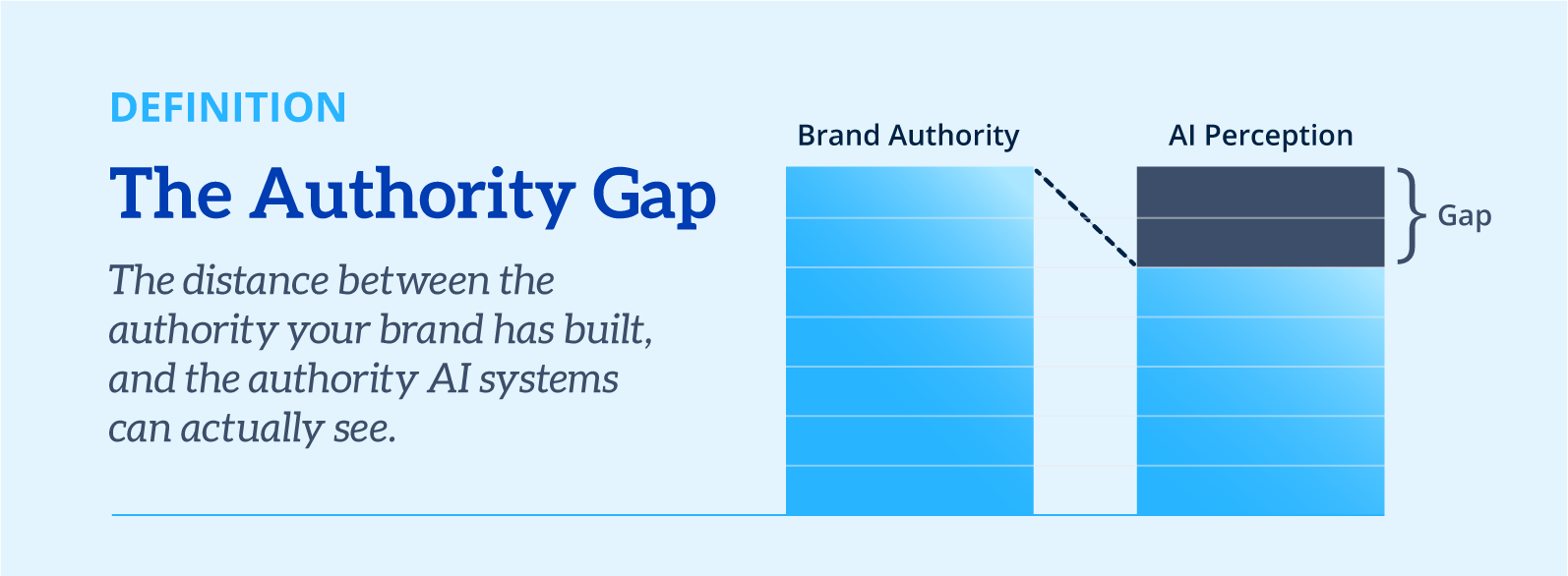
The authority gap is the distance between the authority your brand has built and the authority AI systems can perceive and signal.
-
For most B2B brands, this is a legibility problem more than a quality problem. Content written for human readers and search crawlers does not automatically translate into AI citations.
-
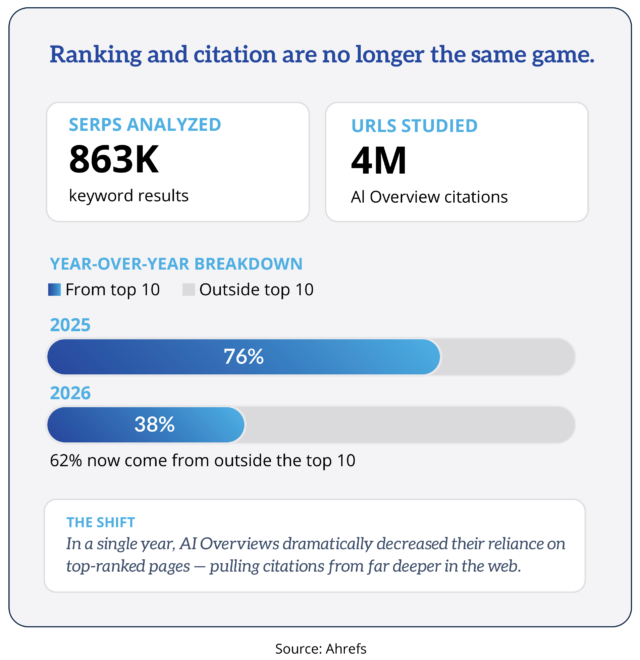
An Ahrefs study of 863,000 keyword results and 4 million AI Overview citations found that only 38% of pages cited in AI Overviews also rank in Google’s top 10, down from 76% the year prior. 62% of citations now come from outside the top 10.
-
The gap is a leading indicator. It appears in AI responses long before it appears in pipeline.
-
The B2B AI Authority Index, developed by Informa TechTarget, measures the gap across six dimensions known as S.I.G.N.A.L.: Strategy, Intelligence, Governance, Narrative, Amplification and Longevity.
Fair warning: the following exercise could sting.
Open ChatGPT, Perplexity, or Gemini. Ask the question your best-fit buyer would ask when they’re one step away from building a shortlist. Then read the answer closely. Not to see where you rank. But to see whether you’re in it at all.
For a lot of marketing teams, the result isn’t what they hoped for. The answer comes back thorough, reasonably accurate, and assembled almost entirely from sources that aren’t you. A competitor you outspend. A trade publication. Occasionally a four-year-old forum thread describing your product in terms nobody at your company would recognize today.
That distance between what you’ve built and what AI systems can can see has a name.
What is the authority gap?
The word carrying the weight there is see.
Your brand might be the real deal. Real product depth. Long-standing customer relationships. Analysts who take your briefings. A content library that took years and a meaningful chunk of budget to build. None of that is in question.
The question is whether any of it is legible to a system that reads the web differently than a search crawler or a person does.
Legibility is the new battle
Years of thought leadership was built for two core audiences: human readers and search crawlers. Both reward things like readability, keyword coverage, and a clean page-one position.
Large language models weigh different things. Authority on its own doesn’t automatically convert to citations. It has to be structured, distributed, and corroborated in ways AI can recognize.
Ranking and citation are no longer the same game
This is where the data gets uncomfortable for anyone still using search position as a proxy for visibility.
Ahrefs analyzed 863,000 keyword results and 4 million AI Overview citations. In 2025, 76% of AI Overview citations came from pages ranking in Google’s top 10. One year later, that figure had fallen to 38%.
62% of AI Overview citations now come from outside the top 10 pages.
In a single year, AI Overviews sharply reduced their reliance on top-ranked pages and started pulling from far deeper in the web. Page-one position used to be a reasonable stand-in for “buyers can find us.” That proxy is thinning fast, and nothing has automatically replaced it on most marketing dashboards.
Want the full picture? Closing the Gap Between Brand and AI Authority unpacks what’s driving this shift and what it means for how you plan brand investment. Download the white paper.
The two-sided trap
The authority gap catches B2B brands from opposite directions.
Brands without established authority are increasingly invisible. AI systems skip them in favor of sources they already recognize as credible. No amount of publishing volume fixes this quickly, because volume isn’t the signal being read.
Some brands with long-standing authority are struggling to translate it to AI systems. This is the harder one to accept. A twenty-year category leader with a wall of awards can lose the citation to a five-year-old competitor with disciplined content architecture and two heavily active analyst relationships. The authority is real. But something just isn’t translating to AI systems.
Why the gap is a leading indicator
The authority gap doesn’t announce itself. It shows up first as absence in AI responses, which almost nobody is monitoring systematically. Then it shows up as slower consideration, because buyers who never encountered you in their research phase don’t put you on the list. Eventually it shows up as a pipeline problem, a win-rate dip, or a quarter where inbound quality deteriorates and nobody can really explain why.
By the time it reaches the revenue conversation, the gap is often 12 to 18 months old and considerably more expensive to close.
That’s the case for measuring the conditions and targeting the weak points before the symptoms take hold. The B2B AI Authority Index was built as an early alert: it determines whether the conditions for AI citation authority are in place, rather than waiting for their absence to surface somewhere painful.
Where do you stand right now? The B2B AI Authority assessment scores your brand across six dimensions in about seven minutes and reveals your archetype. Take the assessment.
You can’t see this from inside the work
There’s another key reason the gap is hard to catch.
Authority doesn’t build in a straight line. You invest, you commission research, you publish, and you actively nurture relationships. Progress is happening, but from inside the work it often feels flat for long stretches. Teams either overestimate their position because they’re too close to the effort, or underestimate it because the effort feels endless.
A diagnostic gives you this higher-level view. Not a page-level assessment of what you published, but a read on whether the conditions you’ve created can support authority across the full buying journey. Six dimensions, evaluated together, with a benchmark you can return to.
Without a baseline, “are we getting better at this?” stays a matter of opinion, and opinions lose budget arguments.
Start with the honest question
In a moment of déjà vu from the early days of SEO, so many of today’s marketers are getting lost in the scramble. “Should we throttle the algorithms to beat competitors to the punch?” “Which tools should we quickly add to the stack?” “Should we get a GEO consultant onboarded tomorrow?”
Resist the panic. Take a step back. And start here: can anyone in your organization describe, with evidence, how your brand is currently represented in AI-generated answers?
All too often, the answer is a shrug. And if that’s the case, the gap isn’t even a hypothetical. It’s there. And it’s unmeasured.
Clarity and an ensuing strategic plan of attack are the most valuable things marketers in this position can have right now.
Ready to see where you stand? Take the B2B AI Authority Assessment.
Frequently asked questions
What is the authority gap in AI search?
The authority gap is the distance between the authority a brand has built and the authority AI systems can see. Brands without established authority are increasingly invisible in AI searches. And even more perplexing, brands with established authority can still be difficult for large language models to recognize and cite.
Is the authority gap a content quality problem?
Usually not. A lot of brands facing an authority gap have produced strong content. The issue is that the content was structured and distributed for human readers and search crawlers rather than for AI systems, which weigh entity clarity, cross-platform mentions, and third-party consensus.
Does ranking in Google still matter for AI citations?
It matters less than it used to. Ahrefs found that only 38% of pages cited in AI Overviews also rank in Google’s top 10, down from 76% a year earlier. 62% of citations now come from pages outside the top 10, which means search position alone is an unreliable proxy for AI visibility.
How do you measure AI authority?
At the most strategic level, AI authority is measured by evaluating the conditions that produce citations rather than counting mentions after the fact. The B2B AI Authority Index assesses six dimensions across the buying journey: Strategy, Intelligence, Governance, Narrative, Amplification, and Longevity.