
Key takeaways
- AI has changed how B2B buyers research. 94% of B2B buyers now use AI tools during the buying process, so they leave fewer of the digital footprints marketers relied on to track demand (Forrester).
- Inferred, account-level intent can guess whether a company is in market, but it can’t reveal who is researching or what problem they’re trying to solve.
- B2B tech buying is a team sport, and more than 40% of deals stall because of misalignment across the buying group (Edelman). To win, marketers need to find the hidden buyers, know what each one cares about, and engage them effectively.
- Directly observed, person-level engagement reveals the who, what, and why behind buying signals. That rebuilds sales’ trust in marketing and powers personalization that converts.
Ask a demand gen leader in 2026 how their buying signals are performing, and you’ll likely get some version of the same answer: not great, but hey, it’s what we’ve got. The reason traces back to how buyers now research. Over the past couple of years, rapid AI adoption has significantly altered B2B buying behavior. Today, 94% of B2B buyers1 report using AI tools during the buying process. As more of that research happens inside AI chat windows, buyers have stopped leaving the footprints marketers traditionally relied on to track them. The result: much of the industry’s visibility has gone dark.
The instinct, understandably, is to look for someone to blame. Bad targeting, weak content, an underperforming team. But it’s not you who’s failing. It’s your data.
“It’s not a you problem; it’s a data problem.” —Anita Covelli, VP, Solutions and Product Marketing, Intent & Demand
For the better part of a decade, demand gen chased scale: more leads, more accounts, more names to fill the top of the funnel. But the buyer, the actual human being behind the job, got lost somewhere along the way. And now, many teams have given up on trusting buying signals entirely.
That resignation is a real issue, especially since it’s often based on inferred, account-level intent. That’s a decaying signal that can only guesstimate whether a company is in market and paying attention. It can’t reveal exactly who is researching or, even more critically, what problem that person is trying to solve.
What matters today is directly observed, person-level engagement: the signal that’s still standing strong. In a zero-click world where intel on your buyers seems to erode by the day, this kind of buyer intelligence makes the unknown buyer known again.
A fraction of the buying group, none of the context

B2B tech purchases have always been a team sport. Budget holders, technical evaluators, end users, and procurement all bring their own priorities, and any one of them can derail a deal. A few years back, the industry went all in on buying-group mapping to account for every player. The energy was great, but the results? Not so much. Most teams mapped the obvious stakeholders and kept missing the hidden buyers, the ones who show up late with objections nobody saw coming.
Even the buyers marketers can see today tend to get the same generic message. Without knowing what each person cares about, outreach doesn’t resonate, and it doesn’t convert. That disconnect costs real pipeline: more than 40% of deals stall2 because of misalignment across the buying group. To win the group, marketers need to find more of the people who matter, know what to say to each one, and move them toward the same decision.
Most marketing teams already suspect the signals they need are sitting somewhere in their stack, too scattered and shallow to act on. That’s the opening AI has here: a way to finally do at scale what marketers have always wanted to do by hand. It can sort through huge volumes of signals quickly and show who’s involved and what they care about, in a form teams can use.
“You could be a prompt genius, but if you don’t have good-quality data going into the system, there’s nothing [AI] can do.” —David Edwards, VP, Product Management, Intent & Demand
There’s a catch, however. Run bad inputs through a capable model and you don’t get a more honest result. You get a wrong one that looks more polished. “AI’s designed to make the data look more impressive than it actually is, which just exacerbates the problem,” says Edwards. “Good data in equals good data out.”
Know the who and why of your buyers again

A name and an email address tell you who someone is, but not what matters most: is this person worth contacting right now, and why? Person-level intent data fills in the gaps, revealing the problem your targets are trying to solve, the topics they’re researching, and even how they’re engaging with your competitors.
Plenty of these people are already somewhere in your CRM, by the way. You know they matter, but not much else. And you certainly don’t know what to say to them.
That “why” is what powers personalization that connects, and you’ll only find it in observed behavior.
“Without the ‘why’ behind the signal, demand marketers and sellers can’t effectively personalize outreach. And every message based on a guess is another message buyers will outright ignore.” — Anita Covelli, VP, Solutions and Product Marketing, Intent & Demand
Missing that “why” doesn’t just leave marketing guessing. It chips away at sales’ trust in the signals marketing hands over. Most reps have been burned before: an account flagged as hot that turned out to be ice-cold, a call that went nowhere fast. So they stop taking marketing’s direction at face value, and real opportunities go untouched.
“Their instinct is to blame marketing for pointing them in the wrong direction,” Covelli says, “when the real problem is that they just didn’t understand the person they were targeting well enough.”
Go off depth, not assumptions
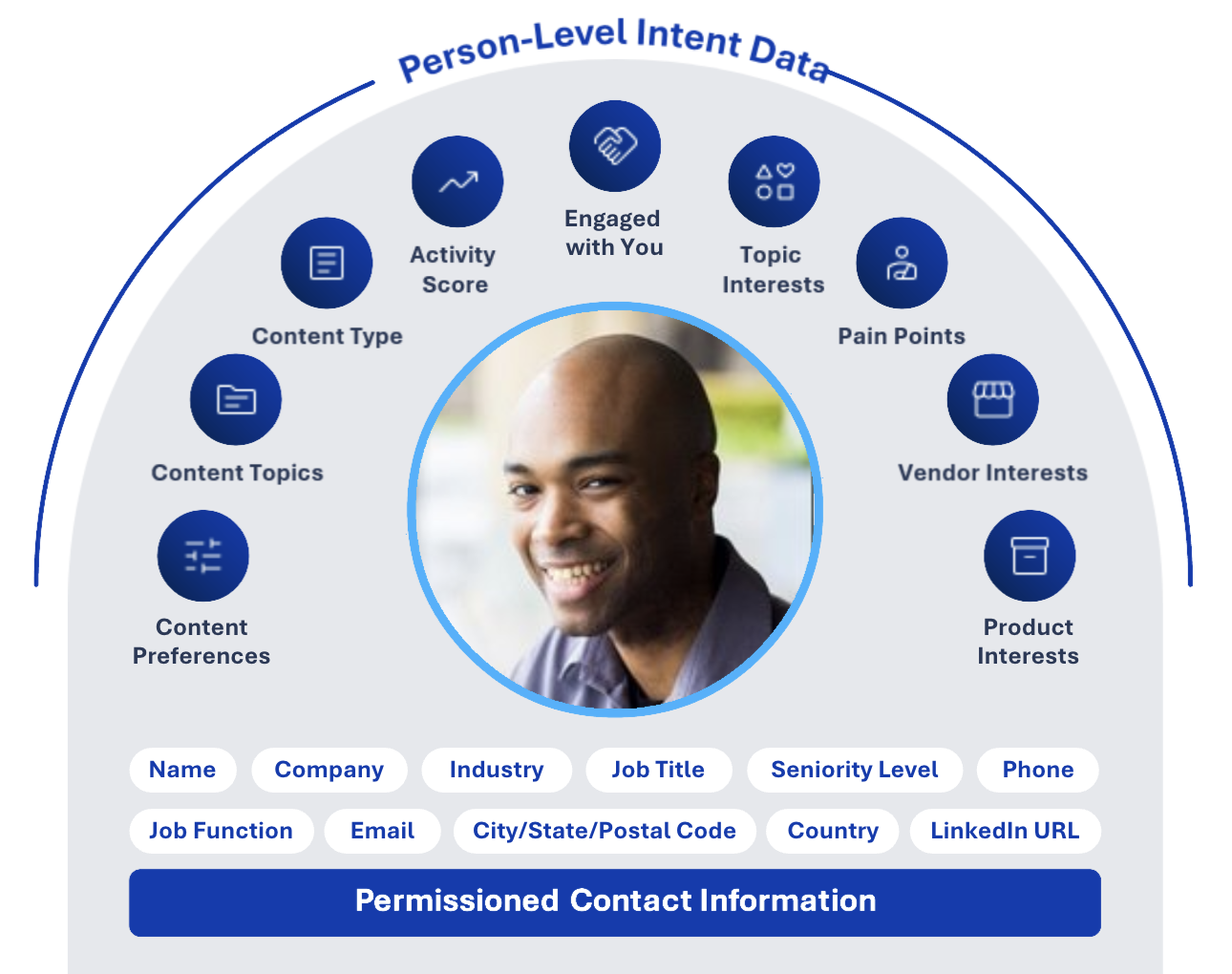
That’s the pattern worth breaking: assuming the data’s bad before checking where it actually came from. In our case, it comes from 58M+ opted-in professionals doing real research across a vast publishing network, not modeled or scraped from somewhere else.
Edwards’ litmus test for any intent data source is simple: does it come from a readership that’s known and understood, or from somewhere further removed? “You advertise in Bon Appétit because the people reading it actually care about food,” he says. The same logic holds for enterprise IT: “real people, living their lives, reading their articles, doing their jobs.”
“You have the opportunity to be involved in that exchange of information.” — David Edwards, VP, Product Management, Intent & Demand
That’s not to say any single source is the only one worth having. What matters more is whether it lines up with something else. When observed and inferred activity agree on the same account, that’s about as much confidence as digital marketing can offer today.
As you take a close look at the buyer intelligence you have now, there are three things worth checking first:
- Are your reps working the leads they’re handed, or leaving them on the table because they don’t trust the quality?
- Can you say why an account is in market, not just that it is?
- For your top accounts, is there one real, nameable person behind the score, tied to something specific they’ve actually engaged with?
If even one answer is no, you’re missing the depth of signal that could change the game for your demand gen operation.
With Informa TechTarget’s comprehensive Buyer Intelligence revealing the who, what, and why behind the signal, the age of the unknown buyer has officially come to an end.
Learn more about Informa TechTarget’s Buyer Intelligence
1 Source: Forrester, B2B Buyers Make Zero-Click Buying Number One
2 Source: Edelman, The Rise of the Hidden Buyer: Rethinking B2B Influence Beyond the Obvious