Key takeaways
- Most intent data is account-level and inferred, meaning it can only guess that someone at a company did something. It can’t prove that a specific person did it.
- AI agents, scoring models, and personalization all need person-level, observed signal. Feed them coarse, inferred data and they return confident recommendations built on guesswork.
- The fix is a change in order: start with click-level engagement, resolve it to person-level intent, then roll up to account and market level. That sequence is what makes data viable for buying-group identification, personalization, and AI workflows.
You bought the most souped-up, precise instruments available today. Scoring models that rank every account, AI agents that queue the next play automatically. A GTM stack built to run on autopilot, exactly as specced.
Still, the pipeline number isn’t moving, even when every signal says you surfaced the right accounts and the right people. The instinct is to blame sales for not trying hard enough, and it’s easy to point fingers, be it at a rep, a campaign, or a target list.
But here’s a tough pill to swallow. It’s your data that’s failing, not them.
“You built this amazing stack, invested in all the right tools. But because you’re feeding it less-than-ideal data, it looks like you’re failing.” — Anita Covelli, VP, Solutions and Product Marketing, Intent & Demand
Everything around it kept getting smarter: warehouse-native pipelines, predictive modeling, software and systems built to act the moment a signal comes in. But the data itself stayed exactly the same shape. Account-level, IP-resolved, inferred, and stale. Passable for a weekly prioritization list, but nowhere near enough for an advanced system that addresses people by name and acts in real time.
The model isn’t the problem

It all boils down to two things: grain and source. Grain is how precise the data is. Account-level is coarse, person- and click-level is fine. Source is where it came from. Inferred signal is a best guess that someone at a company did something. Observed signal is proof that a specific person did it. Most intent data is both coarse and inferred, and that combination is what breaks everything the stack does next.
Data teams read the underperformance as a modeling problem, so they retune the scoring and bolt on another source of signal. The math gets better, but the recommendations don’t. Because you can’t model your way into information the data never had.
That’s the real failure: the right tool with the wrong input. Inferred, account-level signals can’t fuel personalization or AI workflows no matter how good the model is.
“You could have all the signals in the universe. But if none of them actually represent a real activity that someone has seen, they’re all just guesswork, and their fidelity is limited.” — David Edwards, VP, Product Management, Intent & Demand
Inferred person-level intent that never reaches the warehouse, the model, or the agent just sits there. It can’t be modeled, can’t be acted on, and it never turns into pipeline. What it costs you instead is credibility.
The symptoms show up further down the line, where it hurts the most: opportunity volume flat despite the “right” accounts, meetings that get set but don’t convert, win rates that soften. Left unaddressed, this becomes your problem instead of the data’s. Leadership asks why the investment isn’t paying off, GTM teams stop trusting what the system recommends, and you have to explain it all on the weekly pipeline call.
Depth beats volume, every time

All hope for your ultra-modern GTM stack isn’t lost. By raising the bar for the quality of signal you feed it, you can get the results you’ve been after.
The difference starts with a hard look at how the signal gets built. Most intent data providers start with anonymous web scraping, infer the account from an IP address, then guess the person: a high-confidence algorithm putting the odds at a solid chance it’s this specific human. But that confirms activity, not real interest. Useful for account prioritization and broad ad targeting, but not for knowing which individual consumed what.
Flip the order instead:
- Start with click-level engagement.
- Resolve it to person-level intent.
- Then roll up to account and market level.
That’s what makes it viable for buying-group identification, personalization, and AI workflows.
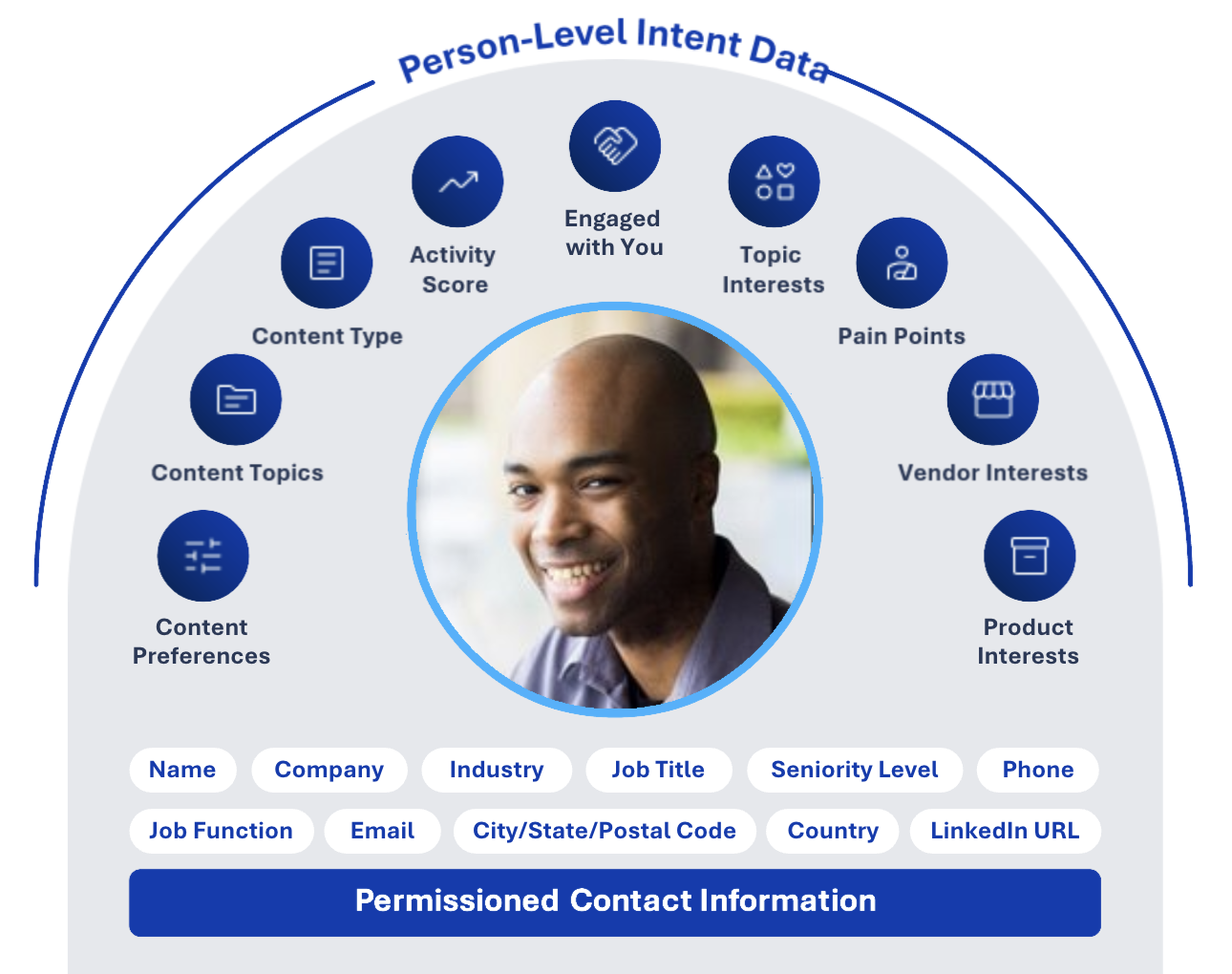
“Think of it like a spreadsheet,” says Edwards. “How many columns of data do you actually get for what you’re paying?” A powerful record should come with a person’s contact details and roughly thirty points of intent behind them, not a name and a guess.
You can also always ask your reps:
- Are they coming back to this source on their own?
- Complaining less?
- Able to work an account without pulling up three other tools just to double-check it?
That qualitative read shows up before the quantitative one does. You can always count on reps to tell you the truth before any report will. The data though? That you’ll have to test yourself.
Test before you trust

Before re-tuning anything, unravel what’s feeding the model. There’s a reason inferred data is so cheap.
“If it were worth something, they’d charge a lot more for it. You should be questioning why it’s so cheap, so available, and why there’s so much of it.” — David Edwards, VP, Product Management, Intent & Demand
You don’t just take a claim on faith, even if it’s coming from a current provider. The first move is to test the data you already have against a plain question: is this observed, or is this a guess?
Start with these:
- Pull a contact record right now. How many of its intent signals are inferred, and how many trace back to something a real, known person actually did?
- Can you trace a signal back to a specific piece of content someone engaged with, or does it stop at “this account showed activity”?
- Is the signal portable? Can it actually reach your CRM, your models, and your AI agents, or is it locked away in a dashboard nobody outside RevOps opens?
You already know how to spot this pattern outside of data. Picture the booth at your last event: one person stopped and talked for 20 minutes, 50 more scanned a badge for the swag and walked on. Both count as “engagement” on a report, but only one is in market.
It’s time to feed your models and systems data that matches their sophistication. No more answering for lackluster performance, and no more models sending sales on a wild-goose chase.
With Informa TechTarget’s comprehensive Buyer Intelligence revealing the who, what, and why behind every signal, you can finally fuel your GTM stack with data that’s just as smart and sophisticated as the stack itself.