
Welcome to the digital marketing attention economy – a fiercely competitive environment where buyers have an increasingly scarce supply of attention to spend and a plethora of vendors vying to capture it. Gaining attention is the first critical step towards building familiarity and, in turn, trust, which is now essential to being deemed credible enough for consideration in the buying process. Simply put? If today’s demand gen leaders don’t gain attention, they’re out of the race before it’s even begun.
Pioneering research and optimizations in the attention economy space is Dr. Karen Nelson-Field, Founder and CEO at Amplified. Through her participation in our demand generation summit – B2B Marketing, Disrupted: Demand’s Path Forward – she reveals what it takes to architect a demand generation program that breaks through and captivates the kind of attention that converts into long-term business success.
Read on for key takeaways from Dr. Karen Nelson-Field’s discussion to help you win more attention in B2B marketing.
Why attention matters in B2B marketing
As Dr. Karen Nelson-Field explains: “… attention is the gateway to memory, mental availability, and ultimately, trust.” – the key component necessary for shortlist consideration. If B2B marketers don’t focus on gaining and maintaining attention, their brand won’t be embedded in the minds of prospects. And in B2B, brands that are not mentally available when it comes time for buyers to make a shortlist simply don’t get considered. Attention success boils down to how you develop and optimize your media and distribution plans, the channels and formats you emphasize, and beyond.
How demand thinking should be evolved for the attention economy
Demand generation in the attention economy revolves around three core principles that serve to unify brand and demand:
1. Mental availability and the three types of attention
If you don’t have buyers’ attention, you create no memories. Without active attention, your brand will simply fail to create a lasting mental impression in prospects’ minds.
As Dr. Nelson-Field’s research shows, digital attention isn’t binary. Instead, she describes it as existing in three forms: active, passive and non-attention. Active attention – where viewers focus directly on your ads – has a much, much stronger relationship to ROI. Studies show that active attention drives:
- 3× conversions (HSBC & SBS, Australia)
- +35% application rates (NAB Bank, Australia)
- +18% consideration (Tourism Australia, global markets)
Passive attention (where prospects can see your ad but don’t focus on it), while still valuable, can’t come close to the impact of the active kind. This point is especially essential for challenger brands. Since they lack the mental availability and trust that larger brands enjoy, they must focus their strategies on maximizing active attention, or risk failing altogether. Passive attention alone can’t achieve the impact required. This has huge implications for both the media that challengers should choose and for the formats they execute in those channels. In the near term, they need to trade off reach for greater attention impact.
Watch now: Generating Demand in the Attention Economy
2. No mental availability = No trust
Mental availability refers to the extent to which a brand will come to a prospect’s mind during buying occasions. If prospects have no mental availability of your brand, there is no trust. In other words, when it comes time to make a shortlist, your brand is neither top-of-mind nor distinctly understood by your prospects.
This is why, in well-known categories, established brands dominate and enjoy a distinct advantage. Because they’ve done the work to gain mental availability and earn the trust of their buyers, they’re reflexively associated with more use cases and stay at the forefront of buyers’ minds. In contrast, challenger brands simply generate fewer instantaneous associations.
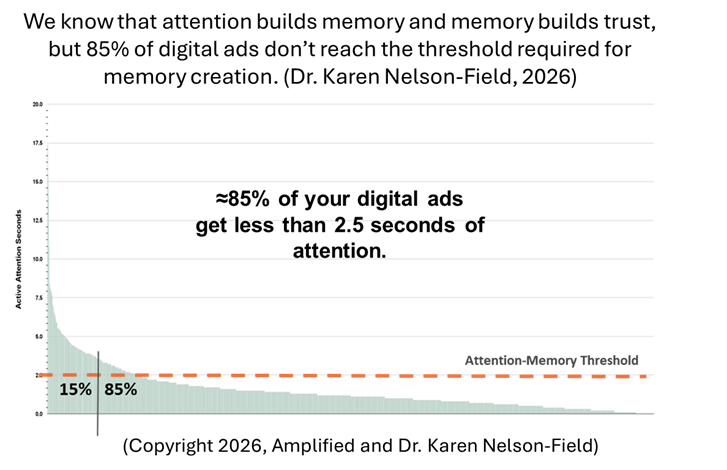
The science of Dr. Nelson-Field’s advertising research articulates a 2.5-second attention memory threshold. Ads that fail to hold attention for at least 2.5 seconds rarely create lasting impressions. This is why it’s so critical for B2B marketers to implement digital strategies focused on:
- Building memory structures through consistent, always-on advertising with a good mix of high-attention channels and formats.
- Ensuring that their executions reinforce brand distinctiveness so that they can better amplify recall.
3. No trust = No deal
Trust is what gives today’s B2B buyers the confidence to shortlist your brand, because they know trusted brands can survive the scrutiny of today’s increasingly complex buying committees. Strong mental availability creates that trust. If you haven’t built it, you won’t be considered in a deal.

Distinctiveness plays a critical role in attention capture and value. Distinctiveness in advertising creative (defined as ads that are easily and uniquely identifiable and that clearly distinguish a brand from others in the category) reinforces existing memories. As Dr. Nelson-Field puts it, “Distinctive assets don’t drive attention seconds, but they amplify the value of attention. This is why Nike is bigger – even without seeing the brand mark completely, you know who they are.” Her research shows that distinctiveness helps make “trust” more retrievable because it helps stimulate previously communicated brand associations.
In short, distinctive ads help amplify previous investments in trust:
- Because they make the brand’s attributes more “retrievable,” distinctive assets (logos, slogans, packaging) amplify the value of a channel’s attention attributes.
- Brands with strongly distinctive assets see a 45% uplift in brand choice compared to non-distinctive competitors.
Three attention-focused demand strategies for B2B marketers
1. Design media for attention
- Use channels that are relevant to a buyer’s business context and choose channel-specific formats that hold attention longer.
- Avoid wasted spend and efforts on low-attention environments where ads are likely to be skipped or ignored.
2. Build memory structures
- Focus on creating mental availability by associating your brand with specific use cases.
- Always use distinctive brand assets, to reinforce consistently across campaigns.
3. Amplify trust using distinctiveness
- Invest in creative development that reinforces your brand’s unique branding attributes.
- Ensure your brand is recognizable and retrievable under pressure.
A digital advertising path forward for B2B marketers in the AI era
In the attention economy and the AI era, success hinges on your ability to capture, sustain and convert attention. By focusing on media with high active attention attributes, using it to build memory structures for trust more effectively and amplifying investments through careful adherence to brand distinctiveness, B2B marketers can ensure their demand generation strategies deliver maximum impact and ROI.
A more thoughtful approach to attention capture is only one element or lever to use in the better unification of all your demand generating efforts. To learn more about how you can maximize the impact of your entire demand program, talk to an expert.
About the Author