- What is Unified Demand?
- Unified Demand is a strategic approach that integrates content, brand and data to help B2B vendors establish authority, build trust and engage the full buying group to drive more marketing-influenced revenue in the AI era.
- Unlike traditional demand generation, it’s a system designed for how buyers actually research and decide today, not a linear funnel built for a buyer journey that no longer exists.
The problem: traditional demand gen was built for a buyer that no longer exists
Ready for the uncomfortable truth? Your programs were engineered for a buying journey that’s been radically and permanently disrupted.
Today, 71% of B2B software buyers use AI chatbots for software research, and more than half start their research with an AI tool rather than a search engine. That makes B2B tech buyers some of the heaviest AI users in the universe. All within the confines of an LLM’s prompt screen, these buyers are shortlisting vendors, drafting RFP criteria and comparing solutions — before they ever engage with owned channels or talk to a seller.
This serious shift in buyer behavior has forced demand gen leaders to operate in an environment that’s anything but familiar or conducive to their success:
- Intent signals are weakening.
- Nearly 60% of searches now end with zero clicks, as buyers get answers directly from AI without ever visiting your site.
- Inbound is shrinking.
- The behavioral data that once powered personalization is drying up.
- Buying groups are growing.
- Today’s purchase decisions involve 13 or more stakeholders from inside the organization alone, each doing their own independent research.
- Trust is harder to earn.
- In a market flooded with AI-generated content, buyers tune out anything but exceptional original content, and default to brands and sources they already know and trust.
The result? MQLs aren’t converting. Campaigns are underperforming. And deals are stalling because key stakeholders within key accounts were never reached in the first place.
Plain and simple, the legacy demand gen models most teams are still running don’t match how businesses actually buy in the age of AI.
The shift: from demand capture to preference building
Forrester has a name for what’s replacing traditional demand gen: preference marketing — proactively shaping buyer perception before active demand surfaces.
The logic is simple: brand builds preference; demand converts it.
When buyers already recognize you, trust you and associate you with authority in your category, your demand programs become exponentially more effective. But if they don’t know you well before they start searching, you won’t make the shortlist, let alone get chosen.
68% of B2B buyers already have a front-runner in mind at the very start of their purchasing process. That front-runner wins 80% of the time.
The goal now is to be that front-runner well before the buying process begins.
What is unified demand?
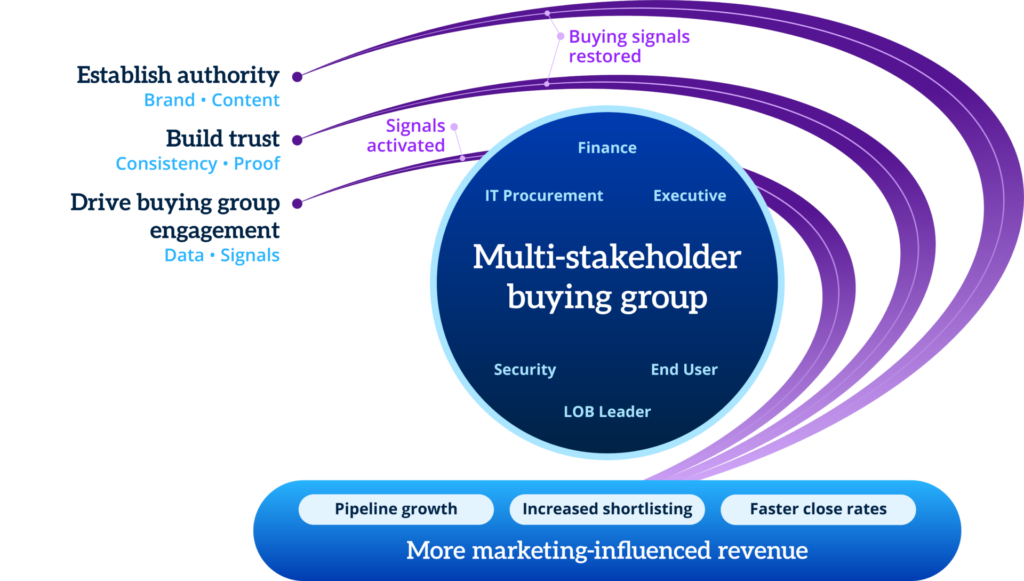
Unified Demand is the strategic answer to this new reality. It brings content, brand and data together as interconnected levers that function as one complete system, not a sequence.
The three levers of unified demand
| Lever | What It Solves | How It Works |
|---|---|---|
| Establish Authority | Content overload & buyer skepticism | Build can’t-ignore content and a chorus of credible voices that amplify it — SME, media and analyst — to make your authority known to buyers well before they’re solution-hunting |
| Build Trust | Zero-click search & invisible buyers | Show up consistently, dependably in the trusted environments buyers already rely on for guidance |
| Engage More of the Buying Group | Signal decay & multi-stakeholder complexity | Use layered intent data to identify and reach every key decision-maker, especially the often-hidden ones (not just your primary champion) |
Together, these levers work in harmony to create conditions for brand preference to form before active demand surfaces — and for precise demand activities to convert that preference into revenue when the time is right.
Lever 1: establish authority and earn the right to be considered
Authority can’t be declared. It must be demonstrated. Especially in a market where buyer trust has eroded so broadly.
The 2026 Edelman Trust Barometer finds 70% of people globally now hold an “insular trust mindset” — hesitant or unwilling to trust sources outside their familiar circles, gravitating toward what feels controllable and known.
Under these circumstances, only the most authoritative voices shape the mental framework buyers use to decide.
The 3 voices of trust
The most effective demand programs build authority through three core voices working in concert:
- The SME Voice: Internal expertise that goes beyond product knowledge to articulate a genuine, differentiated point of view on your buyers’ real challenges. This is what earns credibility with both human buyers and the LLMs they’re turning to for answers.
- The Media Voice: Established media brands have spent years earning the trust of your buyers. Positioning your brand alongside respected editorial voices creates a halo effect that’s nearly impossible to manufacture independently.
- 52% of B2B buyers rely on business and industry news sites to navigate their challenges. Your goal is to appear in the publications they’re already reading.
- The Analyst Voice: Industry analysts are often the direct trigger for vendor engagement.
- 68% of buyers rely on analyst insights when making high-stakes technology decisions. Being cited by analysts buyers already trust is a direct line into the moment a purchase decision begins.
The takeaway:
The vendors who earn the right to shape buyer thinking are the ones who show up across multiple credible voices. Not just their own. To cut through and establish authority, you must lead with only the most original and high-quality content, and architect a chorus of trusted voices to echo it.
Lever 2: build trust through the company you keep
Visibility may get you seen. But only established trust gets you chosen.
A staggering 92% of buyers enter the purchasing process with a shortlist already in mind. Getting on that list requires building brand preference well before buyers come looking.
Consistency is the magic word when it comes to this lever of unified demand. Because repeated demonstrations of social proof in the places your buyers already rely on is what transforms glimmers of authority into lasting trust. Without this drumbeat turning moments into something much larger and more valuable, bursts of authority quickly fizzle.
For your trust-building motion to be effective, it’s critical to recognize the unique habits of each and every buyer.
Consider how a CFO, CIO, and CISO on the same buying committee each follow entirely different research paths:
- The CFO might move from AI Business → CFO.com → analyst reports → peer reviews
- The CIO peruses CIO Dive → InformationWeek → analyst reports → community forums
- The CISO follows Dark Reading → Cybersecurity Dive → peer forums → case studies
It’s imperative to show up at the ‘watering holes’ your buyers regularly flock to. The vendors who appear consistently (with something worth paying attention to) in their trusted editorial spaces earn preference before the formal buying process even begins.
44% of B2B buyers actively trust impartial third-party content more than a vendor’s own content. Time to get more credible voices echoing your claims.
The takeaway:
Stop optimizing only for lead volume. Invest in programs that come with a built-in trust component — consistent presence in the right media environments, with messaging calibrated to each member of today’s multi-stakeholder buying group’s specific concerns.
Lever 3: engage the broader buying group and win more deals
Companies don’t buy. People do.
73% of purchases involve three or more departments, with an average of 13 people inside the buyer’s organization involved in the decision. Yet most demand programs are still built to engage a single champion, missing the full committee and the frequently ‘hidden buyers’ that ultimately determine whether a deal closes or collapses.
Intent data is the silver-bullet solution. But not all intent data is created equal:
- 60% of organizations using intent data struggled to identify members of the buying group
- And 50% of organizations using intent data encounter too many false positives (half the signals are pointing to the wrong account)
Don’t fall into the trap of putting good after bad intent data. The key to the most effective buying group strategies is to layer multiple intelligence sources:
- Market-level intent data: understand which topics are resonating with your target audience
- Account-level intent signals: verify which companies are actively in-market
- Person-level insights: identify exactly who within an account is researching, and reach them directly
The takeaway:
As AI continues to impart ripple effects that decay certain intent models, enhanced signals and targeting have grown increasingly essential. No surprise 53% of demand marketers cite audience targeting as their top priority for 2026 — because reaching the wrong accounts or missing half the buying group is what’s really killing pipeline.
The bottom line
The B2B buying journey has changed. And it’s not changing back. Buyers are forming preferences earlier, researching independently, and arriving at vendor conversations with decisions largely shaped.
Traditional demand generation, built for a world that no longer exists, can’t close that gap on its own.
Unified Demand can. When content, brand and data work together — establishing authority, building trust and reaching more of the complete buying group — preference forms and becomes your most powerful competitive advantage.
The deals you’re working on today are being shaped by buyers who’ve already started making up their minds. The question is: are you influencing them early? Or burning resources by showing up late?
Informa TechTarget’s Unified Demand approach brings together content, brand and data to help B2B vendors build buyer preference and drive more marketing-influenced revenue in the AI era. Learn more about Unified Demand.
About the Author

Marketer Resources